

<b>Agentic AI</b> in your ERP: Industry-ready from day one.
- Industry expertise is built-in, not bolted on
- Ask questions, delegate tasks, and automate processes via chat
- GDPR-compliant, hosted in Germany, no additional license required


For SMEs: Your entry into Agentic AI
An Agentic ERP does not wait for someone to manually trigger a task or request a report.
It understands what is happening, identifies where action is needed or will be needed, and reacts independently—naturally, within defined boundaries. This offers companies many advantages: less coordination effort, fewer missed deadlines, and more room for the decisions that really matter.
The fundamental requirement is an AI in the background that truly understands your industry. Not after a three-month implementation project, but from day one.
At enventa, we draw on four decades of ERP experience in technical wholesale, fashion, and construction to provide industry-specific process expertise.


Digital data, processed by hand
Every day, companies are flooded with countless data in various formats—via email, phone calls, documents, or even paper. And your employees are processing this data one by one.
When it comes to order processing, initial pilot projects show that Agentic AI reduces manual effort by up to 80%.

ERP data is available, but used too rarely
Your ERP data is available, but it needs to be put to use. Currently, you have to navigate through various screens, and reports must be built and adjusted depending on the question at hand.
With enventa EMMA, you can query your ERP data directly in natural language, simply via chat.
Anyone can buy AI features. Industry expertise, however, cannot be bought.
Generic AI models are like well-read, friendly neighbors. They access publicly available information, but they don't know your industry or your processes. They have knowledge, but no understanding.
It is not the intelligence of the model that matters, but whether the AI works within your system or alongside it.
At enventa, our AI is built on four decades of industry expertise: technical wholesale, fashion, and construction. This is the context that turns a language model into an agent.

The Document AI service makes getting started with AI simple
Receipt & Analysis
1. AI automatically reads documents, whether PDF, scan, or email attachment
2. AI automatically reads content and structure
3. No more manual initial entry required
Assignment & Review
1. Recognized data is assigned to the appropriate process
2. Proposal is submitted for review
3. You decide what happens next: Human-in-the-Loop
Transfer & Filing
1. Automatic transfer to ERP after approval
3. Original is archived
4. Complete audit trail: every step is traceable
AI functions in your ERP: available today
In the first step, we focused on AI functions that make day-to-day business easier for all users of our industry ERPs. Because every minute lost in the jungle of supplier data or invoices is a minute that could have been spent on acquisition and customer support.

Trade ERP
Product data from suppliers often arrives only via email as Excel files or PDFs. Every supplier uses a different structure, and language variants or images are often missing: the data is not immediately usable for your own online shop or marketplaces.
- AI automatically extracts the data
- Completes them and handles the translation of master item data
- Suggests completed data records for approval
Available today, so employees can get back to meaningful work.
Coming soon: Query ERP data using natural language via chat.

Fashion ERP
Suppliers send order confirmations and product data in a wide variety of formats—as Excel lists, PDFs, or sometimes just informal emails. Employees then have to check, assign, and copy this data into the ERP. It is a time-consuming task that yields little value.
- AI automatically extracts the data
- Assigns them to the correct items and collections
- Creates the appropriate data record for review
Available today, so employees can get back to meaningful work.
Coming soon: Query ERP data using natural language via chat.

Construct ERP
Order confirmations and supplier acknowledgments arrive via email, PDF, or virtual fax. However, everything comes in a different format with no consistent pattern. An employee reviews them and manually transfers the data into the ERP. When managing multiple construction sites simultaneously, this consumes a huge amount of time every day.
- AI reads order confirmations
- Assigns them to the correct process and supplier
- Creates the process for review in the work queue
Available today, so employees can get back to meaningful work.
Coming soon: Query ERP data using natural language via chat.

AI in enventa Accounting: Automate your incoming invoice processing
Incoming invoices arrive in various formats—XRechnung, ZUGFeRD, or standard PDFs. Previously, vendor details, amounts, tax rates, and line items had to be manually transferred from every document.
- AI-powered invoice processing: Data such as vendor, amount, tax rate, and line items are read automatically.
- Intelligent assignment: The AI assigns the invoice to the appropriate vendor, general ledger account, cost center, tax code, and approval workflow, then suggests an accounting entry.
- Human in the loop: Book in just a few minutes with a few clicks, knowing your accounting entry is complete and accurate.
BI with AI: Ask questions
instead of building formulas
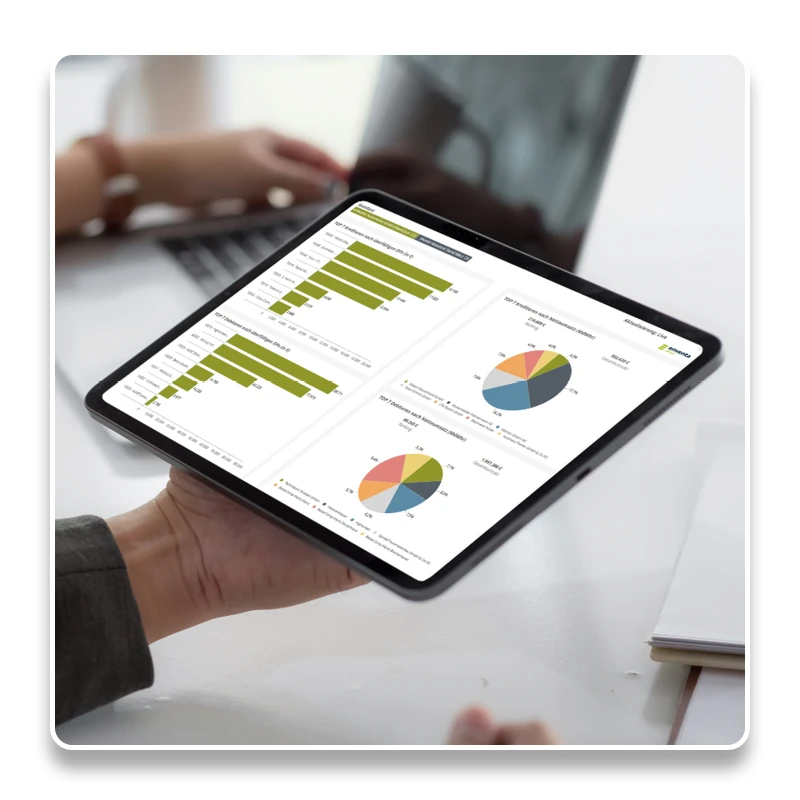
No report editor, no training required. In the BI Reporting module (EIS Builder), simply type your question and the AI assistant generates the finished report. Directly in natural language, with no BI expertise needed.
With the AI assistant in the BI portal, you can analyze existing reports via chat: the AI explains deviations in context and recommends specific next steps.
- Generate reports via text input, no training required
- AI explains deviations and trends in context
- Actionable insights instead of raw data

Book your demo now!

enventa EMMA today. Agentic AI tomorrow.
Ready to go today.
Document AI Service
Structuring data
Processing unstructured data: Whether it's emails, PDFs, or phone orders, enventa EMMA extracts the data and categorizes it according to fixed criteria.
Distribution: Whether it's an order, a booking, or a delivery note, all records land in the right place, already prepared for further processing.
Proactive AI: enventa EMMA makes suggestions and alerts you when action is required
Industry-ready: enventa EMMA knows your industry and your processes. No training or additional onboarding required.
enventa EMMA
AI Agent · Understanding and acting
Natural language queries: Get your answers directly from your ERP, conveniently via chat.
Automated daily business: Access orders, inventory, and customer data via chat.
Proactive AI: enventa EMMA makes suggestions and alerts you when action is required.
Initial automation: enventa EMMA executes pre-defined actions directly within your ERP, including prioritization and decision-making.
Codename NEXA
Automation platform 2027
Automation: enventa EMMA steps become automatic chains and workflows. You define the processes and the triggers.
Trigger-based: Workflows are executed without manual intervention. An order via email is enough to act as a trigger.
Human in the loop: You define which critical decisions require a human to review and approve the results.
Breaking down silos: Tasks currently handled by different departments are merging. Knowledge becomes accessible to everyone.
Strategy, platform, assistant
Three building blocks, one system: How our AI strategy, the Business Hub, and your personal assistant enventa EMMA are connected.

The enventa AI strategy
We are pursuing our AI strategy in three concrete stages. We are starting with our AI assistant, enventa EMMA, which will evolve into an intelligent agent. The third stage
- enventa EMMA understands and makes suggestions
- enventa EMMA begins executing actions in the ERP
- Individual enventa EMMA steps become automated chains
- Vision: Predictive ERP: AI detects errors before they occur

The Business Hub as an AI platform
Experience state-of-the-art technology combined on one platform.
All developed modules & features will be available to all solution users in the future.
- Central module marketplace for all enventa ERPs
- enventa Cloud Connector integrates existing solutions
- Foundation for new AI features such as enventa EMMA and Document AI Service

Who is enventa EMMA?
enventa EMMA is our proprietary AI agent. While voice queries for company data are already possible in some ERP systems, enventa EMMA stands out for its depth. Over four decades of industry expertise have been integrated into enventa EMMA, resulting in a level of understanding and intelligence that goes far beyond generic AI.
- Direct voice queries for ERP data
- First stage of the AI roadmap
- Available in all enventa solutions
FAQ - Agentic AI in ERP
The AI reads incoming documents, assigns them to the appropriate process, and suggests a completed booking or record—including a justification and a confidence score. An employee reviews this suggestion in the enventa Business Hub and approves it before it is entered into the ERP. For clear, recurring cases, the level of automation can be increased; the company decides the extent of this automation.
The AI functions are hosted in Germany and operate exclusively within the EU; data never leaves the EU. It is used solely for processing the specific task at hand and is not used to train AI models. Processing complies with GDPR requirements.
No. The AI functions are an integral part of the enventa Business Hub and work directly with your existing ERP data. This avoids creating a "tool zoo" of separate AI applications that would otherwise need to be integrated with your ERP.
A prerequisite is the use of an enventa ERP system: Trade ERP, Fashion ERP, or Construct ERP. The AI functions are connected via the enventa Business Hub and work directly with the ERP data stored there. Integration with third-party systems, such as SAP, is not supported.
Initial projects show that after a test phase of about four weeks, at least 80% of previously manually entered orders are automatically transferred into the enventa ERP. The exact timeframe depends on the existing order volume and the data quality of the incoming documents. The four weeks are an empirical value from initial projects, not a guarantee.
Initial projects show that the enventa Invoice Manager can process 80% to 90% of incoming invoices fully automatically: The AI reads the invoice, reconciles it with the ERP, and assigns cost centers and cost types. What used to take around 30 minutes per document for initial entry is now completed in seconds. For ambiguous assignments, the AI presents a suggestion to the accountant for approval, which can be quickly accepted or adjusted. Overall, we expect time savings of over 60%. To start with.
For its AI functions, enventa relies on predictable, mid-market-friendly pricing models rather than unpredictable consumption-based fees where costs rise with every request. This ensures budget security for your planning. Specific pricing is determined during a personal consultation, depending on the required modules and the desired level of automation.
Yes, via the enventa Business Hub Cloud Connector, which links existing on-premise installations to the AI functions in the Business Hub. We cover further details on this on a dedicated Business Hub page.